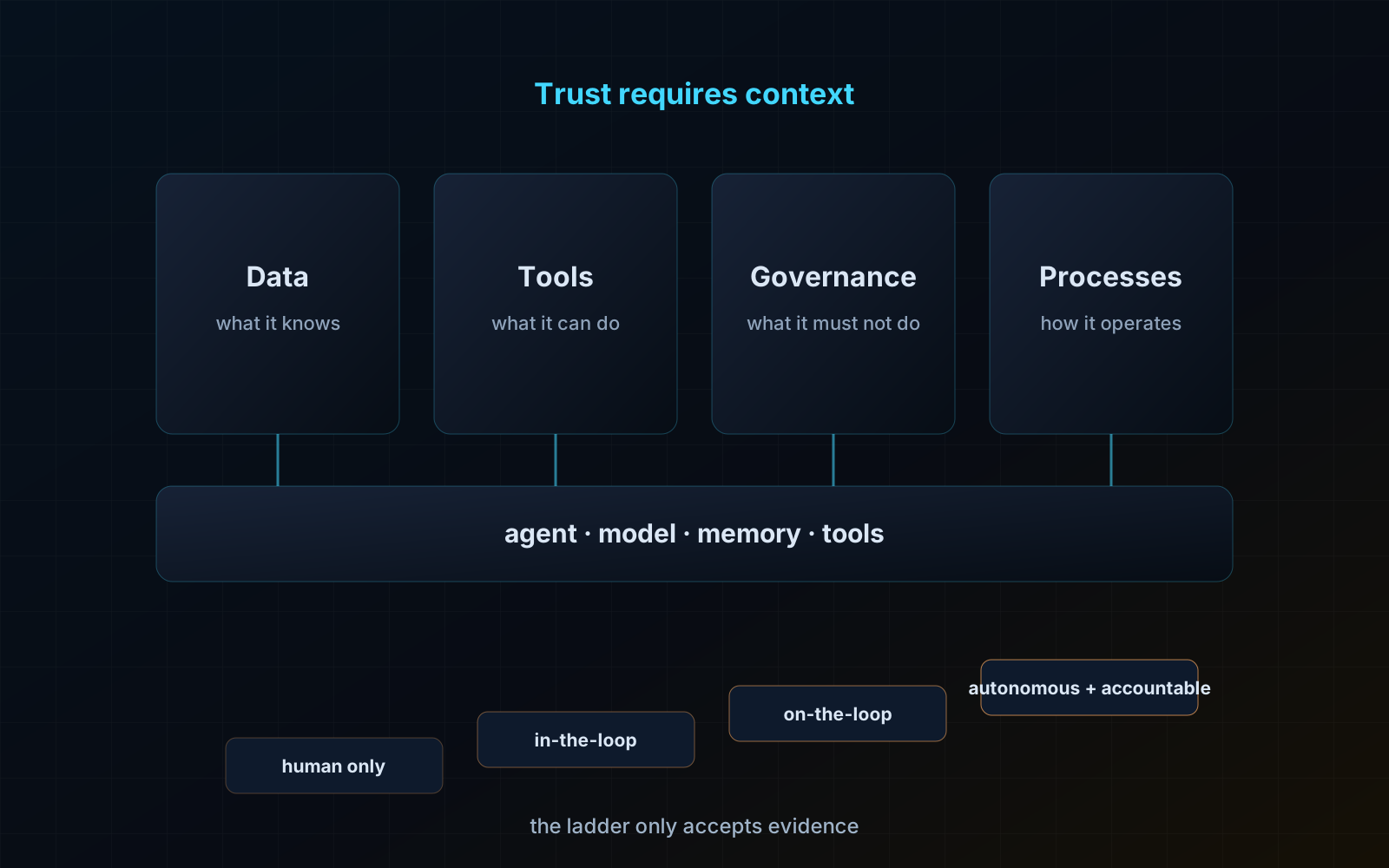
Chatbot training will not save the production system
A consumer chatbot can produce a polished answer from public language patterns. A business system has to know which data is authoritative, which tools may change state, which policies constrain the action, and which process determines what happens next. Prompt phrasing cannot supply those missing contracts.
The distinction is easy to miss because both systems use the same conversational surface. It becomes visible under pressure: conflicting source data, a restricted action, an expired approval, or a request whose answer depends on local operating rules. An enablement program that stops at better prompts trains people for the demo and leaves them alone with the production failure.
Four inventories, four failure modes
Data context answers what the system may know and which source wins during conflict. Tool context answers what the system may do and under whose authority. Governance context defines permissions, budgets, evidence, and escalation. Process context defines sequence, ownership, handoffs, and completion.
The pillars are useful because they make failures diagnosable. A wrong total is often a data-contract problem. A correct answer that cannot be acted on is a tool problem. An unsafe action is a governance failure. A useful draft that never reaches an owner is a process failure. Mixing those cases into a claim that the model was wrong sends the repair to the wrong team.
Autonomy is a ladder of context, not a model setting
At the first rung, a person asks for an answer and judges it. At the second, the system collaborates inside a defined job with approved tools. At the third, the system can initiate and complete bounded work, but only because authority, evidence, and escalation were specified in advance.
Making the model more autonomous without adding those contracts creates the appearance of autonomy while leaving judgment implicit. The model becomes more active, and the organization becomes less able to explain why an action occurred or who was responsible for it. That is a transfer of unstated authority, not a maturity upgrade.
A literacy exercise on one recurring job
Choose one task that already happens every week. Write four short inventories: authoritative data, permitted tools, governing rules, and process stages. Then remove one item from each inventory and predict the resulting failure. The exercise teaches more than a catalog of prompt patterns because it connects system behavior to organizational inputs.
The minimum version does not require a semantic layer or a tool registry. A source-of-truth table, an action allowlist, an approval note, and a process map are enough to expose missing context. Better infrastructure should make those contracts executable. It should not replace the reasoning that produced them.